Employee Engagement Mid-Year Benchmark Report 2026
A more cautious engagement picture is emerging
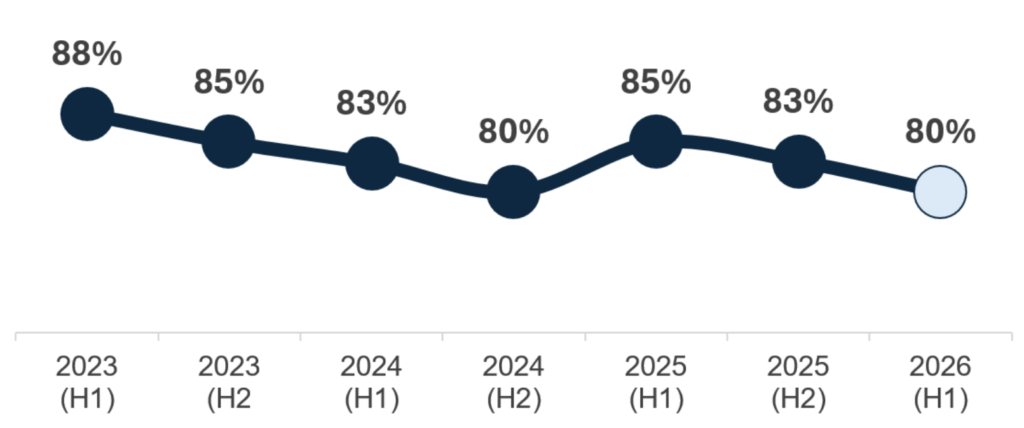
The latest half-year results tell a subdued story. Engagement among organisations surveyed during the first half of 2026 was 79.8%, below both the three-year norm of 82.5% and the unusually strong 85.0% recorded in the first half of 2025.
Together, the findings suggest that engagement has not fallen away dramatically across the wider benchmark, but momentum has weakened during the opening half of 2026.
A note on the data: The one-year benchmarks compare rolling 12-month periods ending at the same point in each year. The H1 figures represent organisations surveyed specifically during the first half of each year and may therefore show greater short-term movement.
What do we see?
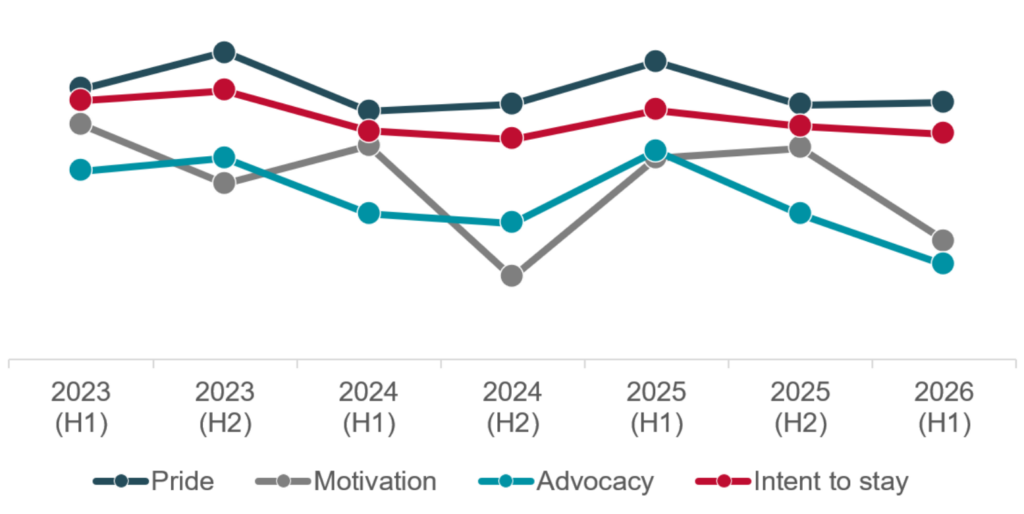
The overall picture is one of continued organisational attachment, but weaker employee energy and advocacy.
Pride and Intent to Stay remain comparatively strong. Employees continue to feel a connection to their organisations and, in many cases, expect to remain with them. However, lower Motivation and Advocacy scores suggest that this attachment is not always translating into discretionary effort or a willingness to recommend the organisation as a place to work.
Engagement has softened during the first half of 2026
The H1 2026 engagement score of 79.8% is almost three percentage points below the three-year benchmark and five points below the corresponding period in 2025
Some caution is needed when interpreting this comparison. The first half of 2025 was the strongest six-month period in the trend, with engagement reaching 85.0% following a weaker end to 2024. The latest result therefore represents a pullback from a particularly positive comparison point rather than an entirely new decline.
Nevertheless, engagement has now fallen to 80% for the first time since H2 2024. This indicates that the recovery seen through 2025 has not been fully sustained into 2026.
Motivation shows recovery over the longer term, but recent momentum has weakened
Motivation presents the most mixed picture.
Across the latest one-year benchmark, Motivation has risen by almost five percentage points, from 74.9% to 79.9%. This reflects a substantial recovery from the low benchmark recorded in 2024 and is one of the most encouraging movements within the data.
However, the organisations surveyed during the first half of 2026 recorded a Motivation score of only 75.2%. This is below the three-year norm and seven points lower than H1 2025.
The difference between the rolling benchmark and the latest half-year result is important. It suggests that stronger Motivation results from the latter part of 2025 continue to support the annual benchmark, while the latest findings point to renewed pressure on employees’ energy and willingness to go above and beyond.
What this means: Organisations should not assume that stable retention or pride automatically indicates a motivated workforce. Workload, recognition, autonomy and employees’ ability to see the impact of their work are likely to remain important areas to monitor.
Advocacy is the clearest area of concern
Advocacy is currently the weakest component of engagement.
The one-year benchmark has fallen by 3.4 percentage points to 75.5%, while the H1 2026 score stands at just 73.0%. This is more than five points below the three-year norm and almost ten points below the equivalent period in 2025.
Employees may still feel proud of their organisation and intend to stay, while being less willing to actively recommend it to others. Advocacy often reflects the overall credibility of the employee experience: whether organisational values are consistently demonstrated, decisions feel fair and employees trust the direction in which the organisation is moving.
The growing separation between Pride and Advocacy is therefore particularly significant. Employees appear to retain an emotional connection to their organisations, but are becoming more cautious about acting as ambassadors for them.
What this means: Strengthening Advocacy is likely to require more than internal communications or employer-brand activity. Organisations need to focus on the day-to-day experiences that shape trust, fairness and confidence.
Pride remains resilient
Pride continues to be the strongest engagement measure.
The one-year benchmark remains high at 86.6%, despite a small year-on-year decline. The H1 2026 result of 86.8% is also broadly aligned with the three-year norm.
This resilience suggests that employees continue to value the purpose, identity or work of their organisations, even where other aspects of engagement are under pressure.
However, Pride has gradually softened from earlier highs. It should therefore be treated as a strength to protect rather than a measure that can be taken for granted.
What this means: Organisations should continue connecting employees to purpose, impact and organisational achievements, while ensuring that the lived employee experience supports the messages being communicated.
Intent to Stay is stable, but retention alone does not tell the full story
Intent to Stay remains comparatively strong and has changed very little over the past year. The one-year benchmark increased slightly to 84.6%, while the H1 2026 result was 84.2%.
This stability provides reassurance that there is no clear benchmark-wide increase in immediate turnover risk. However, the contrast with lower Motivation and Advocacy scores is worth noting.
Employees may remain because they value their organisation, feel uncertain about external opportunities or do not currently see a compelling reason to move. Staying does not necessarily mean that they are fully motivated, positive or willing to advocate for their employer.
What this means: Retention figures should be considered alongside measures of energy, contribution and employee voice. A workforce can remain stable while becoming less engaged in practice.
What should organisations focus on during the second half of 2026?
Rebuild employee energy
The latest Motivation score suggests that employees’ capacity and willingness to invest additional effort may be under pressure. Organisations should examine workload sustainability, recognition, role clarity and whether employees feel able to make meaningful progress.
Understand the Advocacy gap
The widening difference between Pride and Advocacy deserves closer attention. Employees may believe in what their organisation represents while feeling less positive about how it operates. Listening activity should explore what prevents employees from recommending the organisation to others.
Look beyond headline retention
Strong Intent to Stay should not be interpreted as proof that the wider employee experience is healthy. Organisations should monitor signs of passive disengagement, including lower discretionary effort, limited employee voice and weakening confidence in action.
Protect existing strengths
Pride and Intent to Stay remain valuable foundations. Clear purpose, meaningful work and organisational connection should continue to be reinforced, particularly during periods of uncertainty or change.
Focus on consistency
The overall benchmark is stable, but the latest results indicate a more fragile position beneath the headline. Consistent leadership, fair decisions and visible follow-through will be important in preventing temporary pressures from becoming a more sustained decline.
Looking ahead
The first half of 2026 does not point to a collapse in employee engagement. The rolling annual benchmark remains stable, Pride is resilient and Intent to Stay continues to be comparatively strong.
However, the latest results show that engagement has lost some of the momentum built during 2025. Motivation has weakened among the organisations surveyed this year, while Advocacy has become the clearest area of concern.
The key challenge for organisations during the remainder of 2026 will be to convert employee attachment into renewed energy, confidence and advocacy. Those that listen carefully, respond visibly and address the practical factors shaping employees’ day-to-day experience will be best placed to strengthen engagement over the months ahead.